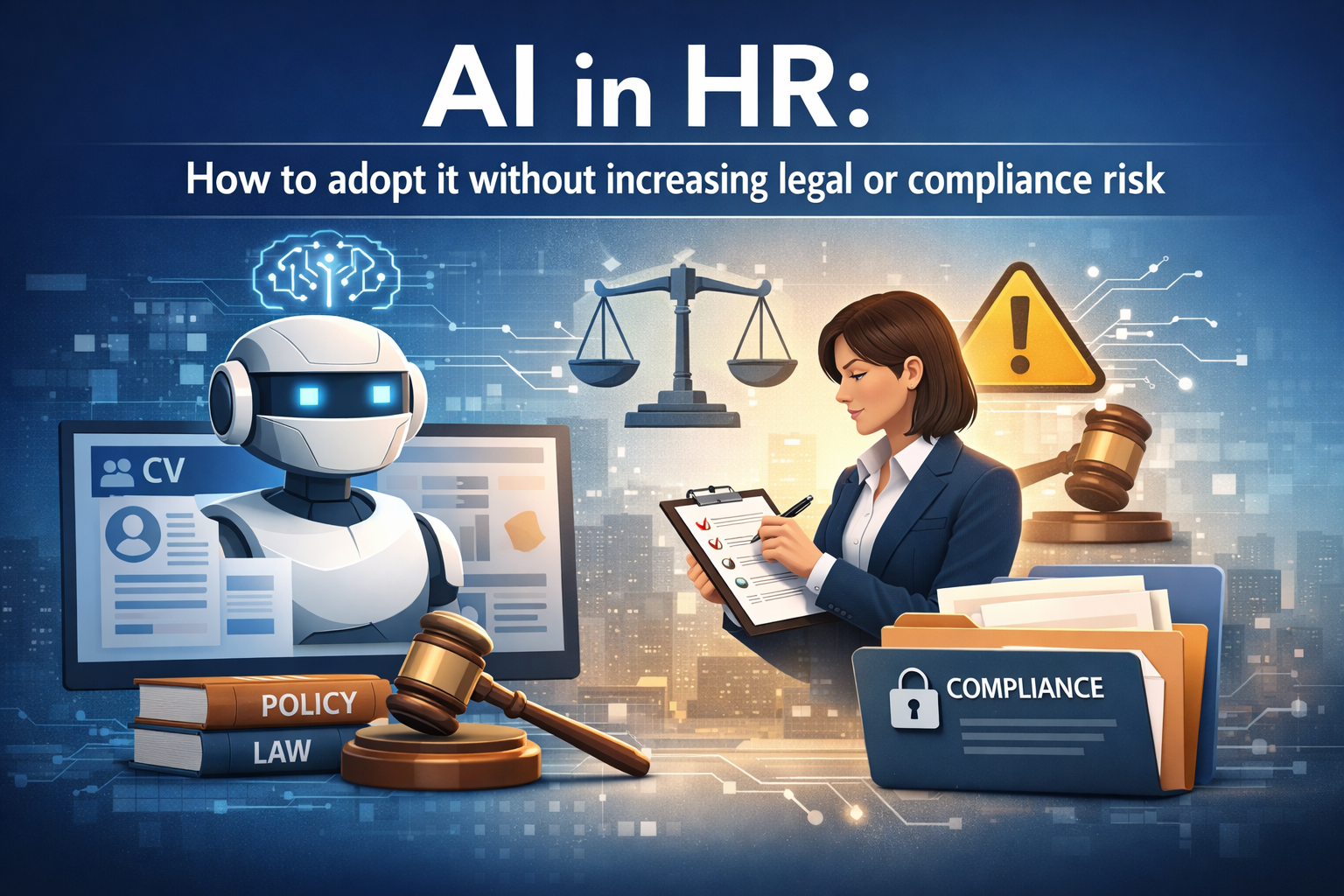
AI in HR: How to adopt it without increasing legal or compliance risk
Artificial intelligence is already reshaping how HR teams work. Not just in productivity and automation, but in how information is interpreted, how decisions are influenced, and how risk is managed.
Here’s the thing. AI itself isn’t the risk. The risk is adopting it without clear governance.
Where AI is already being used in HR
In many workplaces, AI is already assisting with:
- CV screening and shortlisting
- drafting policies, letters, and internal communications
- workforce analytics and trend reporting
- summarising meeting notes or investigation material
- responding to employee queries via chat tools
Used well, these tools can help HR move faster and focus on higher-value work. Used poorly, they can create avoidable exposure in recruitment, employee relations, and privacy handling.
The compliance risks employers underestimate
The most common risks are not “AI taking over HR”. They are practical and human:
Bias and discriminatory outcomes
AI outputs can reflect biased training data or flawed assumptions. If a tool influences recruitment, performance decisions, or employment outcomes, the risk is that certain groups are unintentionally disadvantaged. Employers remain accountable for the decisions made.
Decisions that are hard to justify
If a tool recommends an outcome but the business cannot explain the rationale behind the decision in plain language, that becomes a problem when decisions are challenged.
Over-reliance in sensitive processes
AI can assist with structuring documents or summarising information, but it should not be used as the sole basis for disciplinary outcomes, investigation findings, or termination decisions.
Privacy and data handling risk
HR data is often sensitive. If information is uploaded into tools without clear controls, you can create privacy exposure quickly, especially where data is stored offshore or used to train systems.
What this really means is: AI can support HR, but it can also widen risk if it’s adopted casually.
Principles for defensible AI use in HR
If you want AI to help rather than harm, keep it simple:
Keep humans in the loop
AI can assist, but a capable human must review and own the decision, particularly for recruitment outcomes, performance management, investigations, and disciplinary action.
Use AI as an input, not an authority
The tool supports the work. It doesn’t determine the outcome.
Document how AI was used
If AI contributed to drafting, analysis, or recommendations, note what it was used for and what checks were applied. You’re protecting the integrity of the process.
Build policy guardrails
If your organisation allows AI tools, policies should address permitted use, prohibited use, confidentiality expectations, and approval points.
Practical steps before rolling AI into HR processes
Before AI becomes business-as-usual in HR:
- map where AI is currently being used (including informal use)
- identify high-risk areas (recruitment, ER, investigations, employee data)
- set clear rules on what can and cannot be done with HR information
- train leaders and managers, not just HR
- review templates and procedures so decision-making remains consistent and defensible
What this means for HR leaders
AI adoption does not have to mean increased risk. But it does require discipline.
Organisations that implement AI with governance, oversight, and privacy awareness protect themselves and build trust with employees and leaders.
At TrueNorth HR, we view responsible AI adoption as an extension of good governance, not a departure from it. TrueNorth-HR
Need support adopting AI safely in HR?
TrueNorth HR provides practical, compliance-aware advice to help organisations adopt new tools without compromising decision quality, privacy obligations, or defensible process.
Contact us to discuss how we can support your organisation.